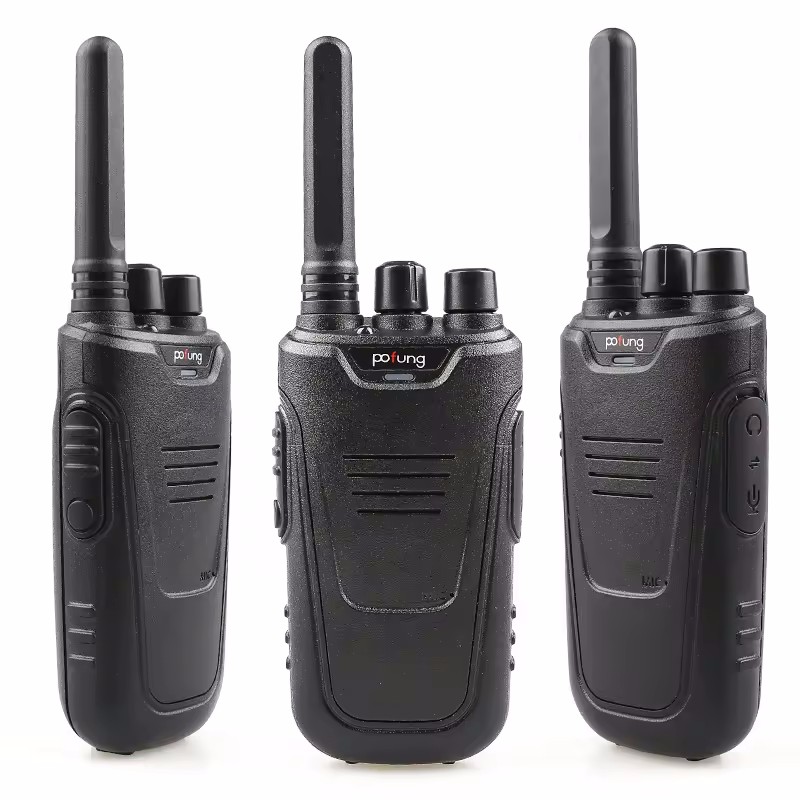
Q1: What is the output power of the T11 walkie talkie and how does this affect the communication distance?
A1: The output power of T11 walkie-talkie does not exceed 500mW ERP (Equivalent Radiated Power) in PMR446 mode, while there are two options in FRS mode, which are 2W and 0.5W. The size of the output power has a direct impact on the communication distance. Generally speaking, the higher the power, the longer the communication distance. However, the actual communication distance is also affected by environmental factors such as terrain and buildings.
Q2: How do the 99 memory channels on the T11 work and what are they used for?
A1: The 99 memory channels of T11 walkie talkie allow users to preset 99 different communication frequencies for quick switching. These channels can be used for different communication scenarios or teams to improve communication efficiency and organization. Users can assign specific channels to specific groups or activities as needed for more organized communication management.
Q3: In which scenarios is the LED flashlight feature of T11 Walkie Talkie particularly useful?
A1: The LED flashlight feature of the T11 walkie-talkie is particularly useful in situations where illumination is required, such as night patrols, emergency response or outdoor activities. It provides a simple and convenient light source without the need for the user to carry an additional flashlight. In addition, the LED flashlight can be used as a signaling device in emergency situations.
Q4: What are the CTCSS and CDCSS features of T11 radios and how do they enhance communication quality?
A1: CTCSS (Continuous Tone Coded Squelch System) and CDCSS (Digital Coded Squelch System) are two technologies used to improve the quality of wireless communications. They reduce background noise and avoid interference from neighboring channels by adding a low-frequency continuous tone or digital coding to the voice signal. This allows users to have a clearer communication experience even in noisy environments.
Q5: What are the advantages of the PC programming feature of T11 Walkie Talkie?
A1: T11 radios support programming via PC, which provides users with greater flexibility and customization. Users can personalize CTCSS, DCS (Digital Coded Squelch), scan list, etc. according to the specific needs of individuals or teams. In addition, PC programming allows batch configuration of multiple radios, which greatly improves configuration efficiency.
Q6: What are the uses of the LED digital display on the T11 intercom?
A1: The LED digital display of the T11 intercom can show the current channel number, CTCSS/DCS settings, transmit/receive status and other information, providing users with intuitive operational feedback. In this way, users can quickly understand the working status of the intercom and operate it accordingly without relying on complicated menus or memorization.
Q7: How does the T11 walkie-talkie's automatic battery saving and low battery warning function work?
A1: T11 walkie-talkie's auto battery saving function will automatically reduce the power consumption when the walkie-talkie has not been operated for a period of time, so as to prolong the battery life. The Low Battery Warning feature alerts the user when the battery is low, preventing important communications from being missed due to battery depletion. Together, these two features ensure walkie-talkie reliability in critical moments.
Q8: What are the Busy Channel Lockout (BCL) and Time Out Timer (TOT) features of the T11?
A1: The Busy Channel Lockout (BCL) function prevents users from accidentally occupying channels that are already in use by other users while communicating, ensuring smooth and organized communication. The Time-Out-Timer (TOT) feature limits the duration of individual communications to prevent a user from occupying a channel for a long period of time and affecting the communications of other users. Together, these two features maintain the fairness and efficiency of wireless communications.